“I Don’t Know What to Write!”
How to help your primary child generate writing ideas (without writing it for them)

Your child sits in front of a blank page.
The pencil hovers.
Then the familiar words come out:
“I don’t know what to write.”
It is tempting to respond by offering a new prompt, suggesting a favourite topic, or gently shaping the idea yourself. The page fills… but the child still has not learned how to fill it on their own.
In many cases, “I don’t know what to write” is not a complete lack of imagination. It is a sign that the child does not yet have a reliable process for finding and developing ideas.
Instead of asking only “What should they write about?”, try asking:
“What is making it hard for them to generate or develop an idea right now?”
What “I Don’t Know What to Write” Can Actually Mean
When a primary-aged child freezes at the start of a writing task, several different things may be happening:
| What you notice | What it may suggest | What to try |
|---|---|---|
| The child stares at the page and says they have no ideas | They may struggle to retrieve ideas under pressure | Talk first. Ask for three possible ideas, even silly ones |
| The child can talk about a story easily but freezes when writing | Ideas are present, but transferring them to the page feels overwhelming | Let them talk the idea through, then write a short version |
| The child keeps asking for a new prompt | They may have become dependent on adult-generated starting points | Teach a short process for generating their own ideas |
| The child starts, then stops and says the idea is “boring” or “stupid” | Perfectionism or fear of choosing the wrong idea may be getting in the way | Generate several options before choosing one |
| The child has an idea but cannot get past the first sentence | They may not know how to expand or organise the idea | Use simple expansion questions (Who? Where? What happens? What changes?) |
The goal is not to diagnose from one moment. Look for patterns across several writing experiences.
Why Giving Another Prompt Doesn’t Always Solve the Problem
Prompts are useful. They can reduce anxiety and get writing started.
But if every piece of writing begins with an adult-generated idea, children get limited practice at the very skills they need: retrieving ideas, choosing among options, and developing a simple idea into something more.
Australian curriculum expectations in the primary years include planning and developing ideas for imaginative, informative and persuasive texts. Idea generation is part of that process, not something that should remain mysterious.
A Practical System for Generating Writing Ideas
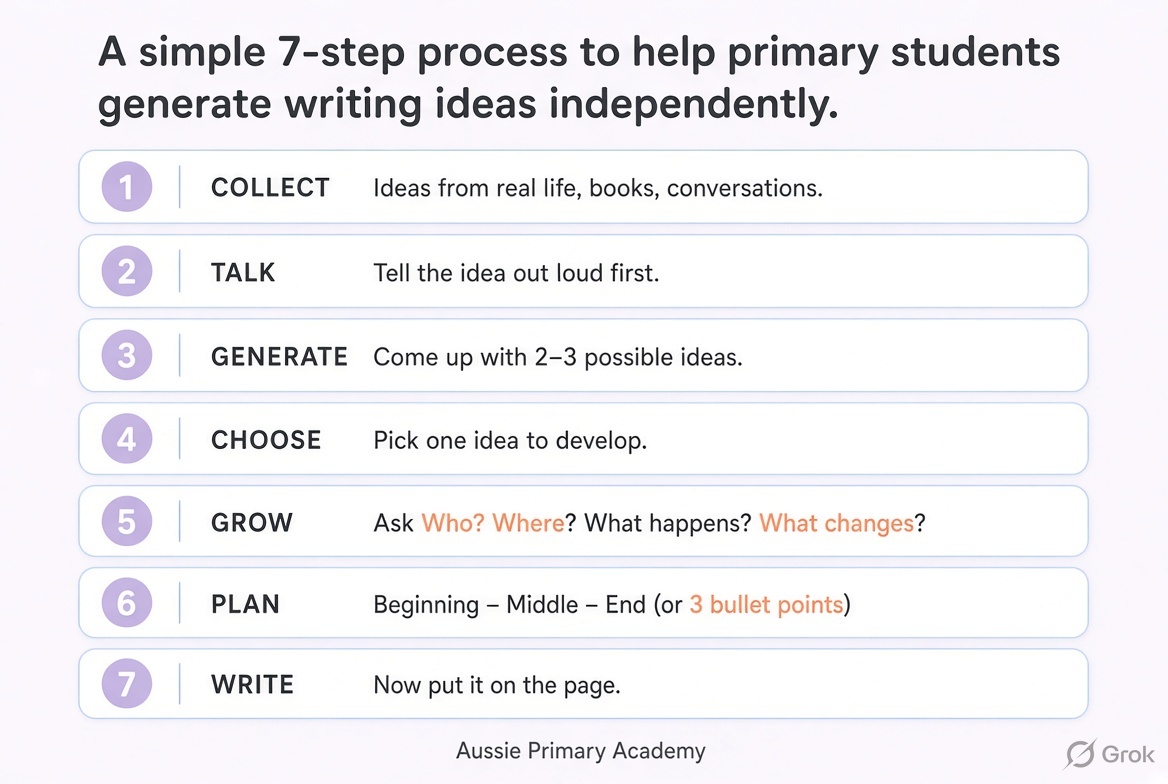
Instead of moving straight from topic to writing, teach this short sequence:
1. COLLECT
Ideas can come from real life, observations, books, conversations, small annoyances or interesting moments.
2. TALK
Ask the child to tell you about the idea out loud before any writing begins.
3. GENERATE
Ask for two or three possible ideas. Quantity first reduces the pressure to find the “perfect” one.
4. CHOOSE
Select one idea worth developing.
5. GROW
Expand it with five simple questions:
- Who is involved?
- Where does it happen?
- What happens or changes?
- What does the character want?
- What can they see, hear or feel?
6. PLAN
A light beginning–middle–end or three bullet points is usually enough.
7. WRITE
Now the child has raw material and a simple structure.
A 5-Minute Idea Builder Activity
You do not need a long lesson.
- Ask your child to tell you three things that happened this week that were interesting, funny, annoying or surprising.
- Choose one together.
- Ask the five growth questions.
- Write three short bullet points (beginning, middle, end or key details).
- Then write.
Example:
Child says: “I don’t know what to write.”
Parent: “Tell me three things from this week.”
Child: “We went to the park… my sister was annoying… I lost my hat.”
Choose: Lost the hat.
Grow: Who was there? Where? What happened? How did you feel? What happened next?
Now there is enough material for a short piece of writing.
How Much Help Is Helpful?
The long-term goal is independence.
Model the process. Do it together. Then gradually step back.
If adults consistently generate the ideas, children learn that the hard thinking belongs to someone else. Short tasks with a real audience can also help. Instead of “Write a page about your favourite animal,” try “Write four sentences that would make your cousin want to know one interesting fact about this animal.”
Frequently Asked Questions
Why does my child say “I don’t know what to write” even about familiar topics?
Familiar topics can still feel overwhelming if the child does not have a process for retrieving and organising ideas under pressure. Talking first and generating several options often helps.
My child can talk about ideas easily but freezes when writing. What is happening?
This is common. The thinking may be working, but the job of holding the idea while also managing handwriting, spelling and sentence structure can overload working memory. Occasional talking-before-writing or light scribing can bridge the gap.
Should I keep giving writing prompts?
Yes, prompts remain useful, especially for reluctant writers. Balance them with opportunities for children to generate and develop their own ideas so the skill has a chance to grow.
What if the ideas they generate seem simple or repetitive?
That is normal at first. Celebrate that they generated them. The growth questions and exposure to good mentor texts help ideas become richer over time.
Is this only for story writing?
No. The same process works for informative and persuasive writing. “Collect” becomes gathering facts or reasons; “Grow” becomes adding details, examples or evidence.
Free APA Writing Resource
The APA Writing Idea Builder walks children through the key steps.
The Bigger Goal
Children do not need perfect ideas.
They need a reliable way to find and develop them.
When “I don’t know what to write” becomes a signal to use a process rather than a dead end, the conversation changes.
Instead of:
“Just think of something.”
you can say:
“Let’s use our idea steps and see what we can find.”
That is where children begin to experience themselves as writers who can generate ideas — not only as writers who wait for ideas to be given.
Sources & Further Reading
- Australian Curriculum Version 9 — English (Creating texts, Years 3–6)
- Australian Education Research Organisation (AERO) — Writing instruction guidance
- Primary English Teaching Association Australia (PETAA) — Writing and idea development materials
- Classroom practice literature on oral rehearsal and idea generation in the primary years
This article is an educational guide. Children’s writing development varies, and some students may need additional targeted support.