Foundation · Maths · Free Printable
Part-Part-Whole: Making 10
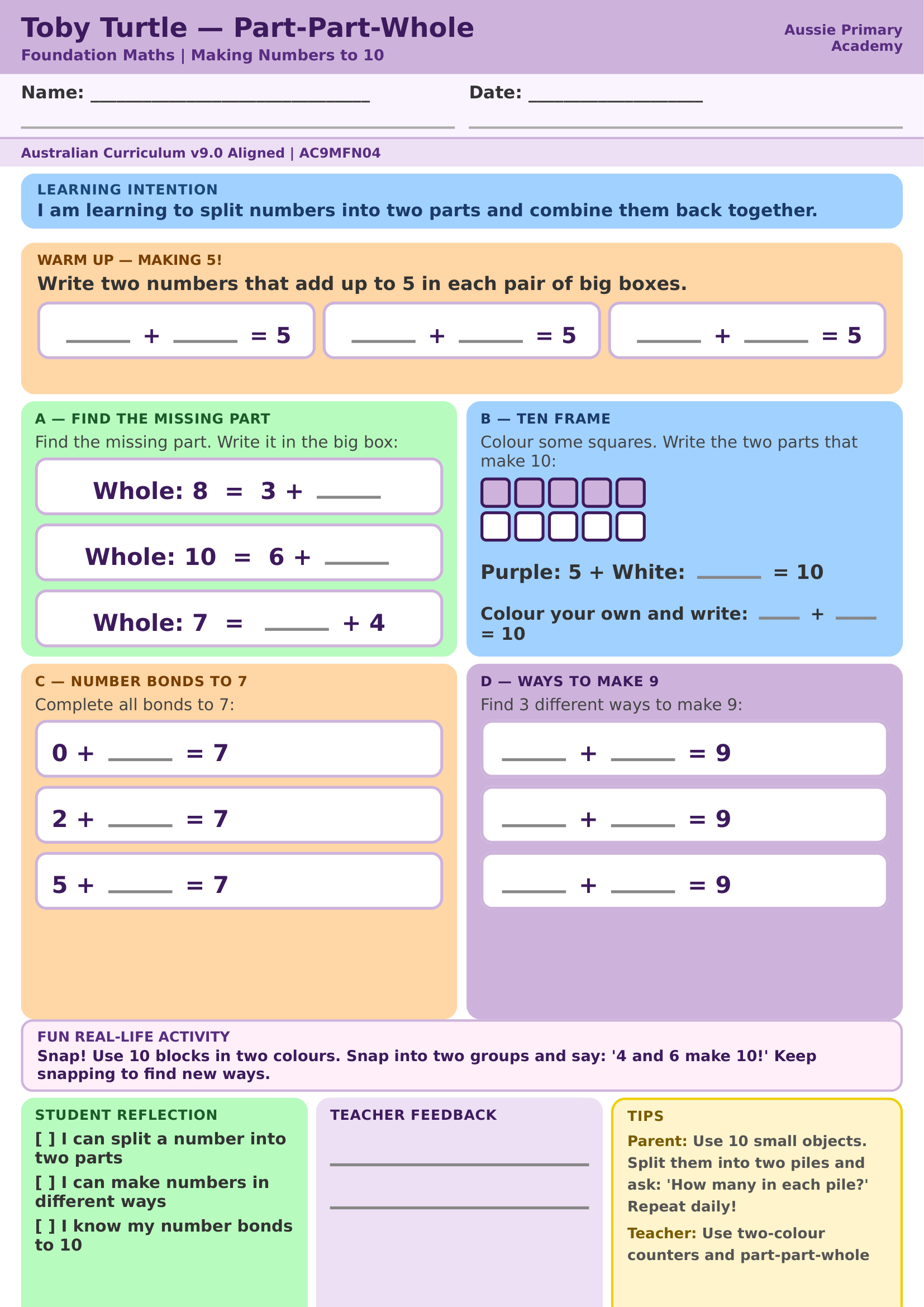
Help children explore how numbers can be split into parts and recombined to make a whole of 10.
Worksheet Preview
Learning Intention
Students explore how a whole of 10 can be made from two smaller parts. They practise recognising number relationships and explaining how the parts combine to make the same whole.
Australian Curriculum
This resource supports Foundation Mathematics learning about representing and combining quantities. The worksheet is aligned to AC9MFN04 and gives children a visual way to explore numbers to 10.
Skills Practised
- Part-part-whole thinking
- Number composition and decomposition
- Counting and combining quantities
- Recognising number bonds to 10
- Explaining number relationships
About This Worksheet
Part-part-whole activities help children understand that a number can be made from smaller amounts in different ways. For example, 10 can be split into 7 and 3, 6 and 4, or 5 and 5. The whole stays the same even when the parts change.
This is an important early number idea because children can use these relationships later when solving addition and subtraction problems. The worksheet provides focused practice after children have had opportunities to build and discuss quantities with concrete materials.
What Students Learn
Children practise looking at a whole and identifying the two parts that make it. They can learn that there is more than one way to make 10 and that the order of the parts does not change the total.
Useful examples to discuss are 1 + 9 = 10, 2 + 8 = 10, 3 + 7 = 10, 4 + 6 = 10 and 5 + 5 = 10. Encourage children to notice the pattern as one part gets larger and the other part gets smaller.
How to Use It
Before starting, give the child 10 counters, blocks or small objects. Ask them to make a group of 10 and then split it into two parts. Have them say the parts aloud, such as “7 and 3 make 10.” Repeat with several different combinations.
Then use the worksheet for independent or supported practice. Ask the child to count carefully, identify the missing part and explain how they know the two parts make 10. If the child is unsure, return to counters or a ten-frame rather than giving the answer immediately.
Teacher Tip
Use a ten-frame alongside the worksheet. Ask students to show one part with counters and fill the remaining spaces to find the second part. This makes the relationship between the known part, missing part and whole visible. Pair students and let them create different ways to make 10 before recording their ideas.
Parent Tip
Practise number bonds during everyday routines. Put 10 small objects on a table and hide some under a cup. Ask, “How many can you see?” and “How many are hiding?” Let your child explain how they worked out the hidden amount. Keep the activity short and playful.
Quick Check
- Can the child make 10 using two groups?
- Can the child find a missing part when the whole is 10?
- Can the child give more than one way to make 10?
- Can the child explain their thinking using numbers, objects or drawings?