Year 5 · Science · Chemical Sciences · Free Printable
States of Matter
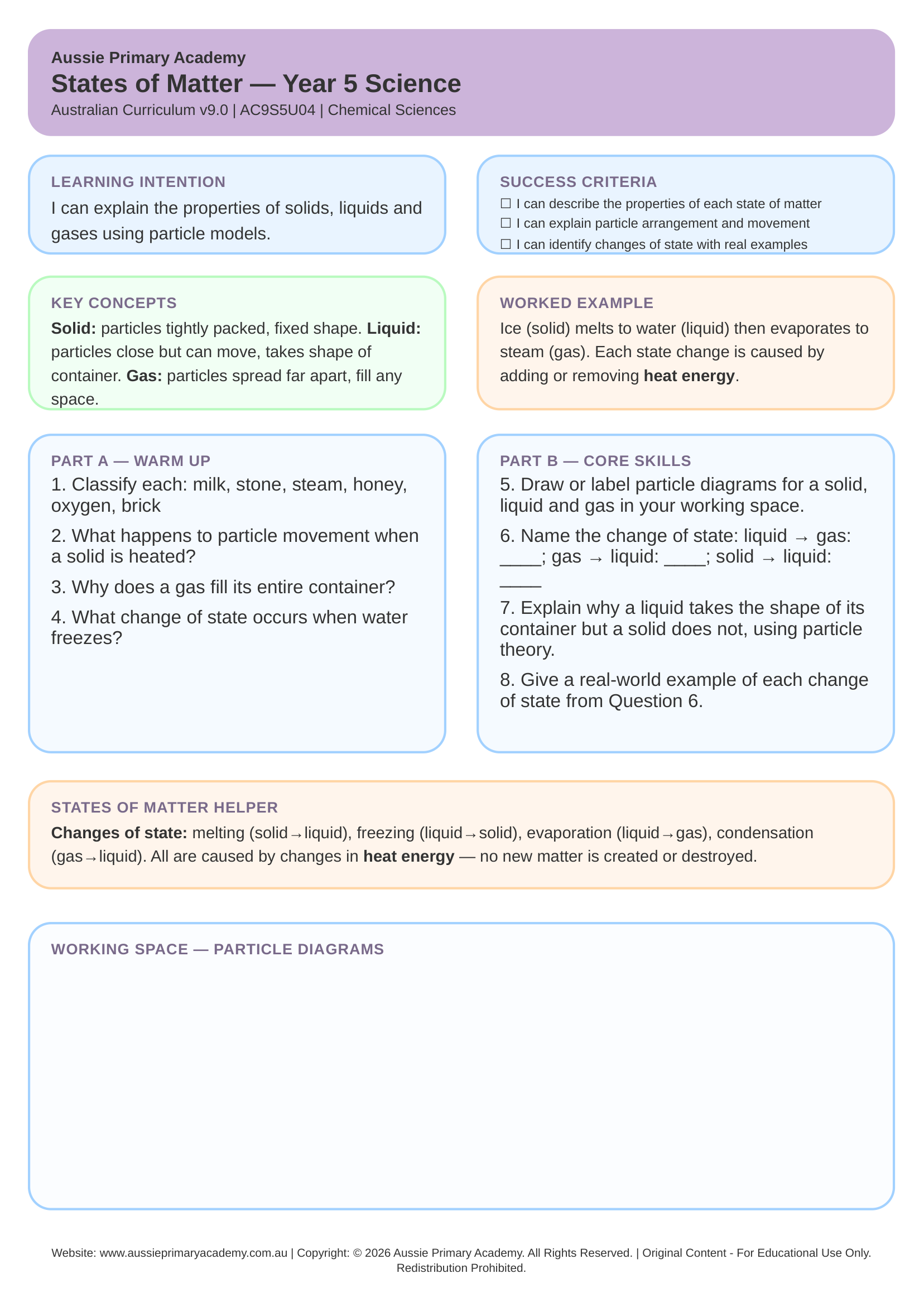
Compare solids, liquids and gases and explain changes of state using particle ideas.
Worksheet Preview
Why families download this one
✅ Instant download, free to download. Ready to print in under 2 minutes — perfect for homework, a NAPLAN-style practice session, or tomorrow's lesson. No email required, ever.
Learning Intention
Students will compare solids, liquids and gases and explain their properties using ideas about particle motion and arrangement.
Australian Curriculum
AC9S5U04
Explain observable properties of solids, liquids and gases by modelling the motion and arrangement of particles.
Teacher Notes
Melting ice or boiling a kettle (with supervision) gives students a real change of state to describe before the worksheet's particle-model questions.
Skills Practised
- Chemical Sciences
- Mathematical/critical reasoning
- Real-life application
- Self-checking against success criteria
Why This Worksheet Works
- Everyday examples (ice, steam, water) ground the particle model in something students already know.
- Comparing all three states side-by-side highlights the pattern in particle spacing and movement.
- Explanation-style questions push beyond labelling into genuine scientific reasoning.
- Written to AC9S5U04, so it drops straight into a Year 5 chemical sciences lesson.
States of Matter — Frequently Asked Questions
Common questions from parents, tutors and teachers about this worksheet.
Is "States of Matter" aligned with the Year 5 Australian Curriculum?
Yes. This worksheet supports AC9S5U04 — explain observable properties of solids, liquids and gases by modelling the motion and arrangement of particles.
Do I need to sign up or enter my email to download?
No. The worksheet downloads instantly as a free PDF — Free to download and print.
Is this worksheet self-checking?
Yes. It includes success criteria (or a worked example) so students can check their own understanding without a separate answer key.
How long does this worksheet take to complete?
Most Year 5 students complete it in 20–30 minutes, depending on pace and prior knowledge.