Foundation–Year 1 · Phonics
What Are CVC Words? A Simple Guide for Parents
Is your child in Foundation or Year 1 and starting to read 3-letter words like cat, dog and sun? Those are CVC words — the most important first step towards reading fluently.
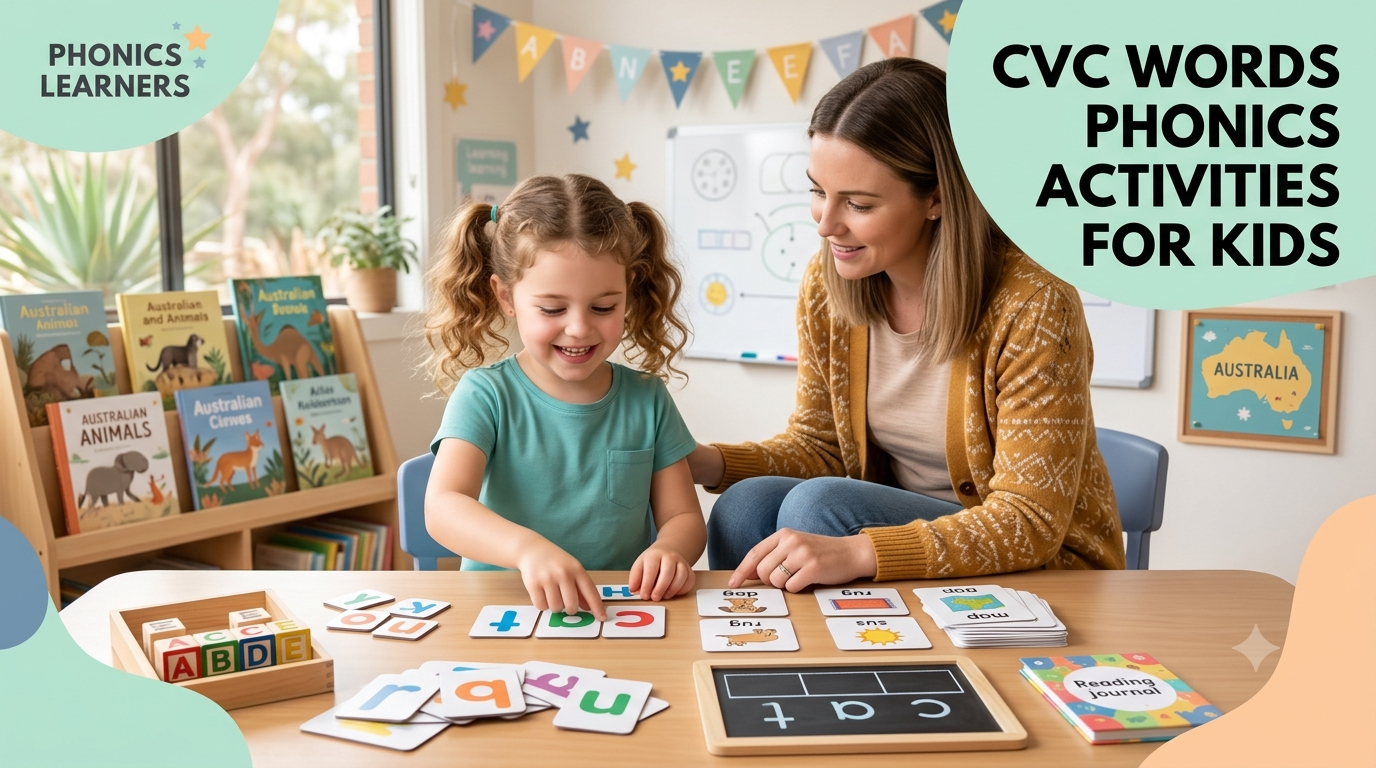
In this guide: What CVC words are · Full CVC word family list · Why CVC words matter for reading · 5-minute home practice ideas · Free printable worksheets · FAQs
What Are CVC Words?
CVC stands for Consonant – Vowel – Consonant. It's a simple three-letter word pattern where each letter makes its most common sound, with no silent letters or tricky spelling rules to trip children up.
Because every sound is heard clearly, CVC words are the easiest possible words for a beginner reader to decode — which is exactly why they're taught first under the Australian Curriculum (Version 9.0) in Foundation and Year 1. Parents looking for more Foundation worksheets can explore our free printable resources.
CVC Word Families List
Grouping words by their ending "family" makes patterns easier to spot.
- -at family: cat, hat, mat, sat, bat, rat, fat, pat
- -og family: dog, log, fog, jog, hog, cog
- -in family: pin, bin, tin, win, fin, sin
- -en family: pen, hen, ten, men, den
- -un family: sun, bun, run, fun, gun
- -ug family: mug, bug, hug, jug, rug, dug
- -op family: top, hop, mop, pop, cop, shop
- -ed family: bed, red, fed, led
Why CVC Words Matter for Early Reading
1. Blending: Putting sounds together to read a word — c–a–t becomes "cat". This is the core skill behind sounding out unfamiliar words. Try our free blending and segmenting CVC worksheet or the focused CVC blending practice sheet.
2. Segmenting: Breaking a word apart into its sounds — "cat" becomes c–a–t. This underpins spelling and phonics-based writing.
Together, blending and segmenting give children the tools to decode almost any short word they encounter, building the confidence they need before moving on to blends and digraphs.
How to Practise CVC Words at Home (5-Minute Ideas)
Short, playful sessions work better than long ones.
1. Oral Blending Game
Say a word sound by sound — "m-a-p" — and ask your child "What word is that?" This builds blending without needing any materials at all.
2. One Word Family at a Time
Focus on a single family (like -at or -og) until your child feels confident, then move to the next. Mixing too many patterns early can slow progress.
3. Find the Sound
Ask questions like "What's the middle sound in dog?" This strengthens segmenting and helps with spelling later on.
4. Use Printable Worksheets
Short worksheet sessions reinforce what your child has practised through play and games.
Start with short A and I CVC words, short E CVC words or short O and U CVC words, then move on to CVC words and captions for simple sentence building.
You can also browse our full range of free CVC and phonics worksheets.
Free CVC Words Worksheets
Our printable CVC worksheets cover word families, blending, segmenting and simple sentence building — free to download, free to download, and aligned with the Australian Curriculum (Version 9.0).
Popular starting points include the beginning sounds worksheet, CVC blending and segmenting, and CVC captions.
Common CVC Blending Misconceptions
These are worth knowing before you assume a child "just isn't getting it".
"They know all the sounds, so they should be able to blend." Knowing individual letter sounds and blending them into a word are two separate skills. A child can say /c/ /a/ /t/ perfectly and still say a completely different word once asked to blend it — that's a normal part of learning, not a sign something's wrong.
"Guessing a word from the picture means they can read." Picture-guessing is a common workaround, not decoding. If a child changes their answer once the picture is covered, it's worth going back to sound-by-sound blending practice.
"More phonics worksheets always help." Extra practice isn't harmful, but if a specific blend keeps tripping a child up, targeted practice on that one pattern (like oral blending games with just that word family) usually helps faster than general repetition.
Parent & Teacher Tips
No worksheet needed for most of these — just a few spare minutes.
- Sound boxes: draw three boxes on paper and move a counter into each one as your child says a sound — c-a-t becomes three counters, three sounds
- Oral blending on the go: "Can you get the /c/ /u/ /p/?" works in the car, at the table, anywhere — no materials required
- Magnetic letters or fridge magnets: build CVC words together and swap one letter at a time (cat → hat → hot)
- "I spy" with sounds: "I spy something that starts with /b/ and ends with /t/" (bat) turns practice into a game
- Keep it short: 6–8 words per session is plenty — stopping while it's still fun beats pushing through when focus fades
Related Worksheets
Free printable Foundation & Year 1 phonics resources that pair well with this guide.
-
Foundation · Phonics
CVC
CVC Blending & Segmenting
Practise putting sounds together and breaking words into individual sounds.
Download Free Worksheet → -
Foundation · Phonics
Spelling
Short A & I CVC Words
Practise CVC words with short A and I vowel sounds.
Download Free Worksheet → -
Foundation · Phonics
Spelling
Short O & U CVC Words
Practise CVC words with short O and U vowel sounds.
Download Free Worksheet → -
Foundation · Writing
Explore More
Jump straight to the matching year hub, subject library or more guides.
-
Foundation · English
Explore Foundation English
Phonics, reading, writing and more free printable Foundation resources.
Foundation Hub → -
Year 1 · English
-
Blog · Guides
More English Guides
Practical teaching and parent guides with free printable links.
All Blog Guides →
You May Also Like
Related parent and teacher guides from the APA blog.
-
Year 1 · Phonics
Year 1 Phonics Check Parent Guide
What the Year 1 Phonics Check involves and how to support your child calmly at home.
Read Guide → -
Foundation · English
Free Foundation Prep Worksheets
Practical prep activities and free printables for the start of primary school.
Read Guide → -
Maths · Foundation
Foundation Maths Worksheets
10 fun ways to build early number sense with free printable maths worksheets.
Read Guide →
Frequently Asked Questions
When should a child start learning CVC words?
Most children start CVC words in Foundation, once they know most letter sounds from A to Z. Some begin earlier if they're confident with individual sounds.
What are 10 easy CVC words to start with?
Good starting words include cat, dog, sun, pen, hat, big, map, bed, cup and log.
What comes after CVC words?
After CVC words, children usually move on to consonant blends (bl, st, cr) and digraphs (sh, ch, th), followed by CVCC and CCVC word patterns.
Are CVC worksheets free to download?
Yes. Aussie Primary Academy's printable CVC words worksheets are free to download, free to download.
Keep Learning
Explore more free Australian primary worksheets, activities and teacher resources aligned to the Australian Curriculum.